AI for a Quebec SME in 2026 does not start with a big technology project, but with one well-chosen process. The most profitable use cases are customer service by chatbot, phone answering by an AI voice agent, administrative automation, invoice processing and writing assistance. An audit, a focused pilot and clear metrics are enough to get started.
Where do Quebec SMEs stand on AI adoption?
Official figures show real adoption, but still far from universal:
- According to Statistics Canada, in the second quarter of 2026, 19.2% of Canadian businesses reported using AI to produce goods or deliver services. Notably, very small businesses (1 to 4 employees) sit at 19.9%, compared with 27.8% for businesses with 100 or more employees. The most common uses are data analysis (36.6%), text analysis (34.5%) and virtual agents or chatbots (28.2%).
- In Quebec, the Institut de la statistique du Québec reported that in the second quarter of 2025, 12.7% of businesses were using AI applications, with a marked gap between large businesses (26.1%) and those with 1 to 4 employees (12.2%). The main barriers cited for digital investment are high cost (27.2%), uncertainty about return (19.3%) and lack of specialized knowledge (14.3%).
- BDC found that 30% of Canadian SMEs were using AI in 2025, and those that did were 24% more productive.
- Among individuals, the NETendances 2025 survey by the Académie de la transformation numérique shows that 52% of Quebec internet users have already used a generative AI tool. Your customers and employees are already familiar with these tools.
The takeaway is simple: most SMEs have not started yet, and the three main barriers (cost, uncertainty, skills) are exactly what a small, measured pilot approach addresses.
What are the 5 most profitable use cases for an SME?
1. Customer service by chatbot
A business chatbot answers repetitive questions 24/7 (opening hours, order tracking, pricing, return policy), qualifies requests and books appointments. It draws on your own content, in French and English, and hands off to a human whenever needed.
2. Phone answering by an AI voice agent
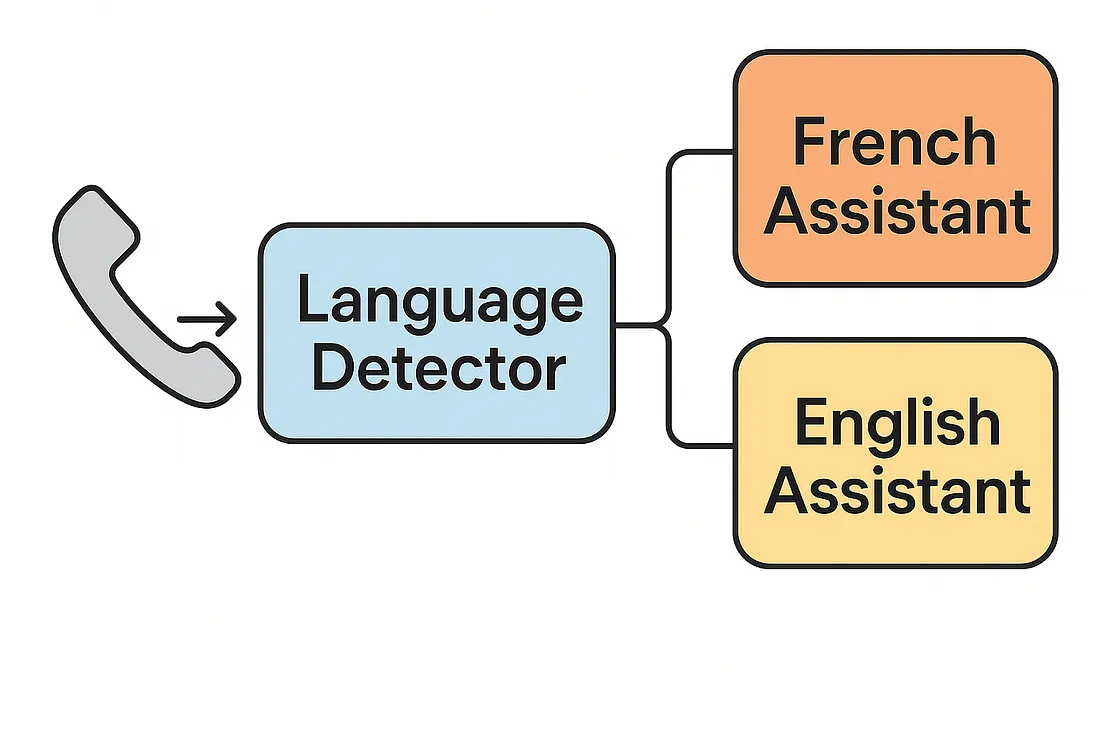
For a clinic, a garage, an accounting firm or a retailer, every missed call is a potential customer lost. An AI voice agent answers calls, books appointments, handles frequent questions and transfers complex cases, even outside business hours.
3. Administrative automation
Copying data between two applications, payment reminders, onboarding new clients, generating weekly reports: process automation removes the repetitive tasks that eat up hours every week.
4. Invoice and document processing
Intelligent document processing automatically extracts data from supplier invoices, purchase orders and forms, validates it and pushes it into your accounting system. Data-entry errors drop and month-end closes faster.
5. Writing and analysis assistance
Drafting emails, summarizing meetings, analyzing quotes, preparing marketing content: this is often the cheapest entry point, provided the team is trained to use these tools well and to protect personal information. That is the focus of our AI training for businesses.
Comparison table: effort, impact and time to results by use case
| Use case | Implementation effort | Typical impact | Time to results |
|---|---|---|---|
| Customer service by chatbot | Low to medium | Fewer repetitive questions, 24/7 answers | 4 to 8 weeks |
| Phone answering by AI voice agent | Medium | Zero missed calls, appointments booked automatically | 6 to 12 weeks |
| Administrative automation | Low to medium | Several hours recovered per week per employee | 3 to 8 weeks |
| Invoice processing | Medium | Less data entry, fewer errors, faster accounting close | 6 to 10 weeks |
| Writing and analysis assistance | Low | Individual productivity, better quality deliverables | 1 to 2 weeks (with training) |
Where to start? The 5-step method
Step 1: the audit
Map your processes, identify where time is lost and what data already exists. Check Law 25 constraints as well (personal information, Canadian hosting). At Zenidata, this audit is free.
Step 2: prioritization
Rank use cases on three criteria: volume of repetitive tasks, value recovered (hours, sales, errors avoided) and technical ease. The first project must be visible, measurable and achievable within weeks.
Step 3: the pilot
Deploy a solution on a limited scope: one channel, one department, one document type. The pilot is used by real people with real data, but with a human safety net.
Step 4: measurement
Compare against the starting point: missed calls, invoice processing time, email response time, satisfaction rate. Without baseline numbers, you cannot prove the return.
Step 5: rollout
Once the pilot is validated, extend it to other channels or teams, train employees and set up ongoing monitoring. This is also the moment to line up a second use case.
What budget should you plan, step by step?
These amounts are indicative and consistent with our service pages; every project receives a precise quote after the audit.
| Step | Indicative budget (CAD) | Comment |
|---|---|---|
| AI audit | Free | Review of processes, data and Law 25 obligations |
| Prioritization and scoping | Included in the audit | Roadmap and estimate per use case |
| Team introductory training | From 1,500 | Half-day or full-day workshop |
| Chatbot pilot | From 3,000 (most projects: 5,000 to 20,000) | Depending on integrations, content and channels |
| Automation or invoice-processing pilot | 4,000 to 25,000 | Depending on number of processes and connected systems |
| AI agent pilot connected to your systems | From 5,000 (most projects: 8,000 to 35,000) | Depending on data sources and autonomy |
| AI voice agent | On quote | Depending on call volume and integrations (calendar, records) |
| Measurement and wider rollout | Variable | Often a fraction of the pilot cost, reusing existing building blocks |
What mistakes should you avoid?
- Starting too big: an "assistant that does everything" almost always fails. A chatbot that answers the 20 most frequent questions succeeds.
- Ignoring Law 25: personal information sent to a tool hosted outside Canada without an assessment, or no notice that the user is talking to an AI. Compliance costs less up front than in remediation.
- Not measuring: without a baseline, the project becomes a matter of opinion.
- Forgetting employees: tools that are not adopted return nothing. Plan training and involve the people doing the work today.
- Choosing the tool before the problem: technology is the last choice, not the first.
- Neglecting maintenance: up-to-date content, conversation reviews, monthly adjustments.
Are there grants or financing for AI in SMEs?
Yes, and the offer is growing. In April 2026, BDC launched LIFT, a CAD 500 million initiative that pairs eligible SMEs with AI advisors and offers financing from CAD 25,000 to 5 million, with the option to defer principal repayment for up to two years. Other provincial and federal programs (workforce training, digital transformation, tax credits) exist and change regularly. We are preparing a full article on available grants: check our blog to find it as soon as it is published, and raise the question during your audit.
How does Zenidata support Quebec SMEs?
Based in Quebec City, Zenidata supports SMEs across the province with solutions hosted 100% in Canada and designed to comply with Law 25: chatbots, AI agents, AI voice agents, process automation, invoice processing and training. We always start small, measure, then scale.
Ready to identify your first use case? Request your free AI audit: in one meeting, you leave with a prioritized list of projects, an indicative budget and a pilot plan.
Last updated: August 23, 2026
Frequently asked questions
How much does a first AI project cost for a Quebec SME?
A custom business chatbot starts at CAD 3,000, and most automation or invoice-processing projects fall between CAD 4,000 and 25,000 depending on scope. The initial audit, which sets a precise budget, is free at Zenidata.
Which AI use case pays off fastest for an SME?
Customer service by chatbot and phone answering by an AI voice agent are usually the fastest to deploy and to pay for themselves, because they immediately cut missed calls and time spent on repetitive questions. Invoice processing follows closely when monthly volume is significant.
Do I need perfect data before starting an AI project?
No. A well-scoped pilot works with the documents, emails and procedures you already have. What matters is picking a clearly bounded process, measuring the starting point and improving step by step.
How long does an AI pilot project take?
A chatbot or a simple automation typically goes live in four to eight weeks, from audit to production. An AI voice agent or an AI agent connected to several systems often takes two to three months.
Is there financial support for SMEs adopting AI?
Yes. For example, in April 2026 BDC launched LIFT, a CAD 500 million initiative combining guidance from AI advisors with financing from CAD 25,000 to 5 million. Other provincial and federal programs exist and change regularly.